
Loading...
Serving Longview, TX and surrounding areas. (430) 267-1851
Bare concrete keeps your basement feeling like a storage area. We prep the slab right, address moisture first, and apply a finish that turns it into a room your family actually uses.
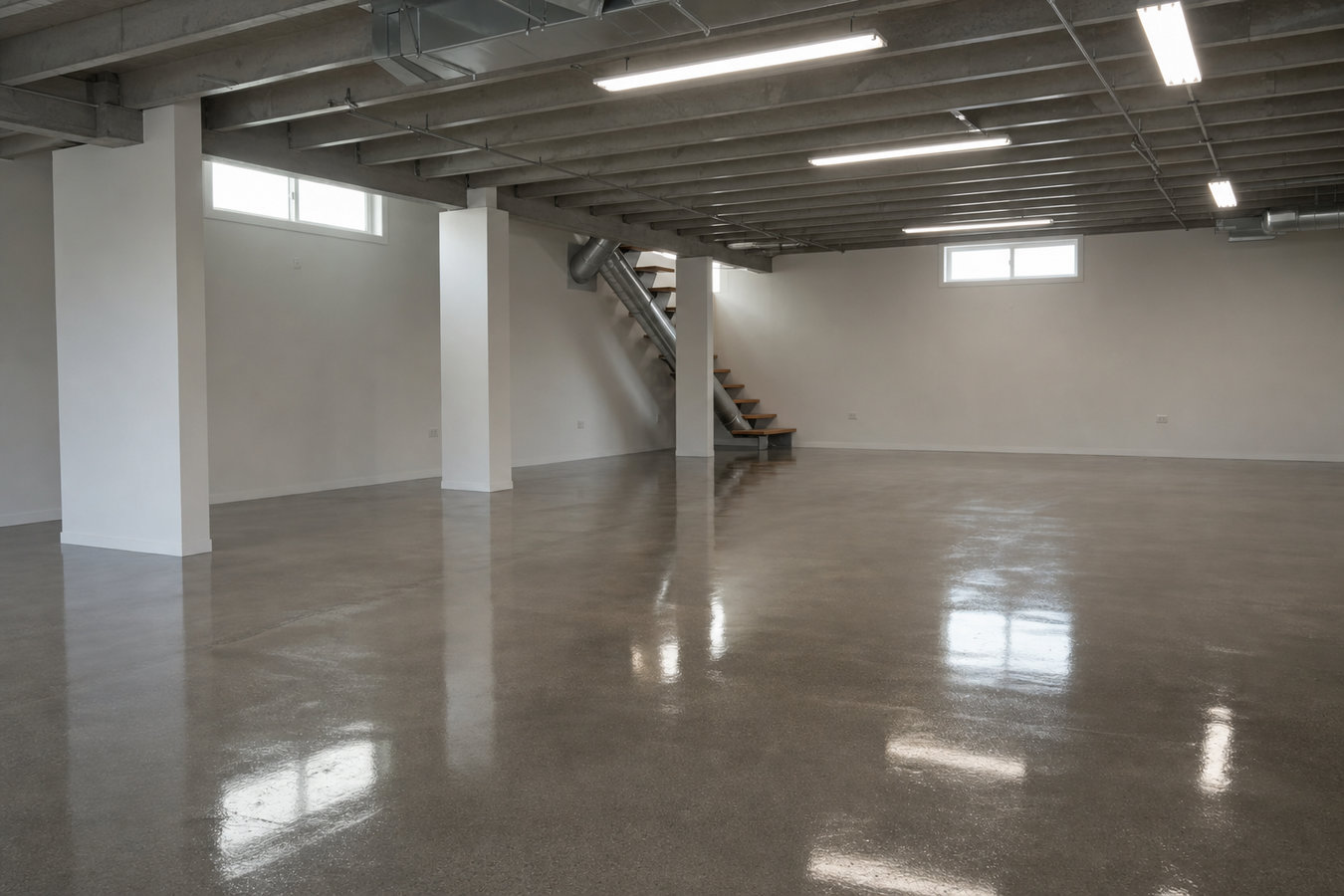
Basement flooring in Longview means finishing the concrete slab that is already there - through coatings, polishing, or overlays - and most projects take one to two days of work plus 24 to 72 hours of curing time before the space is ready to use again.
The biggest mistake homeowners make is choosing a finish before dealing with what is underneath it. In Longview, that means moisture from the clay soil and slab movement from seasonal expansion and contraction. A coating applied over an untreated slab will bubble, peel, or crack within a year or two - no matter how good the product is.
The right finish depends on how you actually use the space. A home gym needs something different than a playroom or a storage area. That is why we walk through the basement with you before recommending anything. If you are also dealing with surface prep questions on the slab itself, our concrete grinding and surface preparation page explains what that process looks like.
If you can see cracks running across the slab, chunks that have broken away, or spots where the floor feels noticeably higher or lower than the rest, the surface needs attention before it gets worse. In Longview, the clay soil underneath shifts with every wet and dry season, so small cracks that go unaddressed tend to grow over time.
A white chalky film on the concrete - sometimes called efflorescence - is a sign that water is moving up through the slab and leaving mineral deposits behind. This is especially common in East Texas after heavy rain seasons, and it tells you moisture needs to be dealt with before any new flooring goes down.
Bare, unsealed concrete naturally sheds fine dust as it ages. If you are constantly wiping down surfaces in your basement or noticing a gritty film on boxes and stored items, a sealed or coated floor would eliminate that problem entirely.
If a coating was applied without proper prep - or if moisture has worked its way underneath - you will see it lifting away from the surface in patches. This is a sign the floor needs to be stripped back to bare concrete and done correctly. Our team handles full coating removal before any new system goes down.
Surface preparation is what separates a basement floor that holds for ten years from one that fails in the first season. Before any finish goes down, we grind the slab mechanically to open up the surface, repair cracks, and test for moisture. In Longview homes, that prep step often reveals issues that need to be fixed first - and we address them before applying a single coat of anything. For homeowners who want a hard, low-maintenance surface that is part of the concrete itself, concrete grinding and surface preparation is where that process starts.
From there, the finish we recommend depends on your basement and how you use it. A protective epoxy coating works well for homeowners who want color, easy cleanup, and resistance to spills. Polished concrete is better for spaces where the floor will see constant foot traffic and where a hard, seamless surface matters most. For basements that need a moisture barrier built into the system, we include that as part of the base coat - not as an optional add-on. If you want to understand how sealing fits into long-term floor maintenance, our concrete sealing page covers what to expect.
A thick, bonded surface coating suited for basements used as home gyms, playrooms, or workshop spaces where spill resistance and easy cleanup matter most.
Ground smooth and sealed from the slab itself - a hard, dust-free surface that handles constant foot traffic without a separate coating layer that can peel.
For Longview basements that show signs of water intrusion after heavy rain - a moisture-resistant base coat applied before any finish to stop the problem at the slab.
A thin layer applied over the existing slab to create a fresh, level surface - useful when the existing concrete is stained or uneven but structurally sound.
Longview averages around 46 inches of rain per year, and the clay soil here does not drain quickly. That combination means basement slabs in this area are under more moisture pressure than in drier parts of Texas. When heavy rain rolls through, water can work its way up through an unsealed slab or in through cracks at the perimeter. Any floor finish that goes down without a moisture barrier underneath is at risk - and in East Texas, that risk is not theoretical.
The housing stock adds another layer of complexity. A significant share of Longview's neighborhoods were built in the 1950s through 1980s, and those slabs have had decades to absorb moisture, crack from clay soil movement, and collect old coatings that were never properly stripped. Homeowners in areas like Marshall and Henderson frequently find that the prep work takes longer than expected on older slabs - and that is exactly the work that determines whether the finished floor lasts or fails.
We respond within one business day. We will ask about the size of your basement, what it is currently used for, and whether you have noticed any moisture or damage. A good estimate cannot be done over the phone - we will schedule a time to come see the space in person.
We walk the floor and look for cracks, moisture signs, uneven spots, and the condition of any existing coating. We ask how you plan to use the space so we can recommend the right finish. You get a written estimate that breaks down prep work, materials, and labor - not a single lump-sum number.
You clear everything off the basement floor before we arrive. We then grind, clean, and repair the slab - filling cracks, removing old coatings, and making sure the surface is ready to hold the new finish. On older Longview slabs, this step sometimes takes most of the first day.
Once the slab is prepped, the coating or finish goes down in the correct number of coats with drying time in between. After curing, we do a final walkthrough with you - check the whole surface, answer questions, and give you a specific timeline before you move things back in.
Free written estimate - we assess your slab for moisture and cracks first, no obligation, and reply within one business day.
(430) 267-1851Longview basements are under real moisture pressure from the clay soil and heavy rainfall. We test every slab for moisture before recommending a finish - because a coating applied over a wet slab will fail, and we are not going to let that happen on your floor.
We grind every slab with professional equipment before applying any coating. That prep is what creates the bond that keeps the finish from peeling. Skipping this step - or replacing it with a quick acid wash - is the most common reason basement floors fail within the first few seasons.
Longview's heat and humidity make flooring applications tricky - the wrong approach in these conditions leads to finishes that do not bond correctly. We schedule work during conditions that let the product cure as designed, and we use products formulated for high-humidity environments.
We follow American Concrete Institute guidelines for slab preparation and floor finishing. These standards exist because concrete work done incorrectly is far more expensive to fix than to do right the first time - and they are why our finishes stay bonded in East Texas conditions.
Every one of those practices shows up in the finished floor - a surface that bonds properly, handles Longview moisture, and stays looking good without constant maintenance or early failure.
The mechanical prep work that makes any basement floor coating hold - grinding, crack repair, and surface profiling done before any finish is applied.
Learn MoreA protective sealer applied to finished basement concrete to lock out moisture, stop dusting, and make the surface easy to clean with a simple mop.
Learn MoreEast Texas summers make scheduling tight - call now or submit a request online to lock in your estimate and get your slab assessed before the season books up.